Anodic molecular hydrogen formation on Ru and Cu electrodes
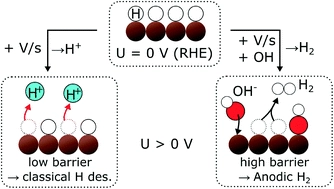
A previously undiscovered phenomenon: adsorbed hydrogen on Ru and Cu electrodes desorbs as H₂ during anodic sweeps — at potentials where H⁺ desorption would be expected. Observed and quantified via EC-MS on Ru(0001) in acid and polycrystalline Cu in alkaline, the effect appears linked to *OH adsorption and a high barrier for the Volmer step, favouring Tafel-step H₂ desorption over the thermodynamically preferred H⁺ route.