Surface Hydride Formation on Cu(111) and Its Decomposition to Form H2 in Acid Electrolytes
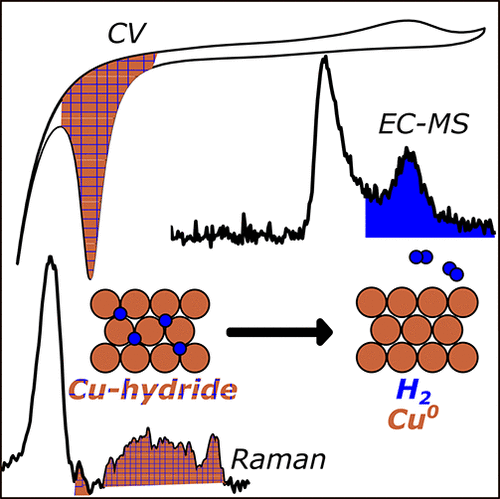
Cu(111) uniquely forms a surface hydride coincident with anion desorption, which decomposes to yield H₂ by recombination rather than oxidation — confirmed by MS and Raman spectroscopy across multiple acid electrolytes. The effect is absent on Cu(110) and Cu(100), and the hydride phase may play a catalytic role in CO₂ reduction to CH₄.