Allotrope-dependent activity-stability relationships of molybdenum sulfide hydrogen evolution electrocatalysts
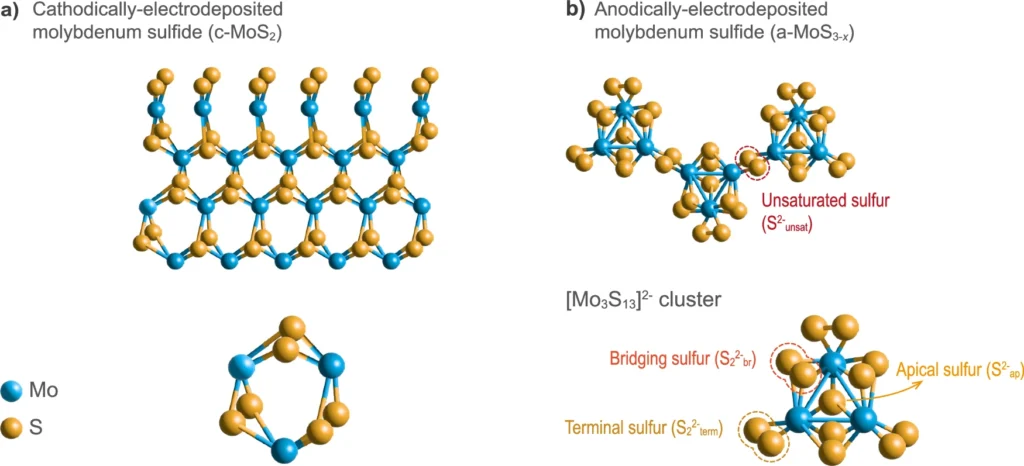
MoS₂ HER stability is allotrope-dependent: lamellar MoS₂ degrades under open circuit conditions, while amorphous MoS₃ₓ loses sulfur during HER, generating undercoordinated Mo sites. Simultaneous ICP-MS and EC-MS monitoring of dissolution products underpins revised stability metrics and a proposed HER mechanism accounting for both Mo and S dissolution pathways.
Real-Time Detection of Acetaldehyde in Electrochemical CO Reduction on Cu Single Crystal
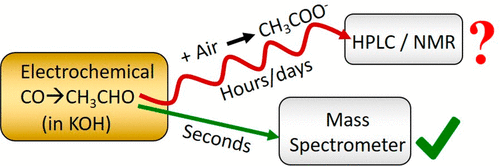
Heads up — this abstract doesn’t match the title. The title references acetaldehyde detection in CO reduction on Cu, but the abstract is about a TAS additive for zinc metal batteries. Could you check and paste the correct one?
How Solvation Energetics Dampen the Hydrogen Evolution Reaction to Maximize Zinc Anode Stability
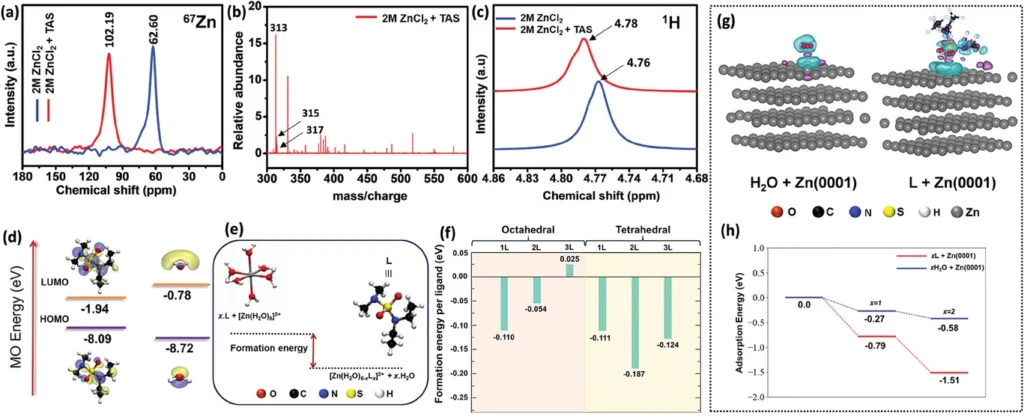
A tetraalkylsulfonamide (TAS) additive displaces water from the Zn²⁺ solvation shell, suppressing HER by an order of magnitude and eliminating dendrite and passivation layer formation. EC-MS confirms real-time HER suppression during Zn electrodeposition, translating to a ~25-fold cycle life improvement — from ~100 h to over 2500 h.
Gold Nanoparticles for CO2 Electroreduction: An Optimum Defined by Size and Shape
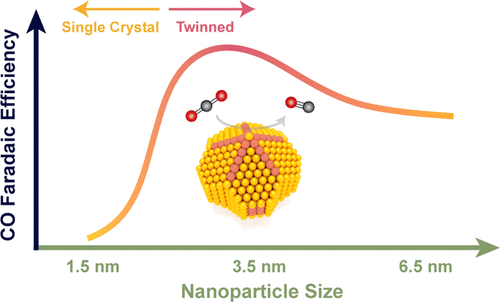
Size-selected Au nanoparticles peak in CO selectivity at ~3 nm, reaching 60% faradaic efficiency at low overpotentials. HRTEM identifies multiply twinned particles as the favourable morphology, with 8-fold coordinated surface sites at twin boundaries pinpointed as the key structural feature — offering a rational design target for CO₂-to-CO catalysts.
For Zinc Metal Batteries, How Many Electrons go to Hydrogen Evolution? An Electrochemical Mass Spectrometry Study
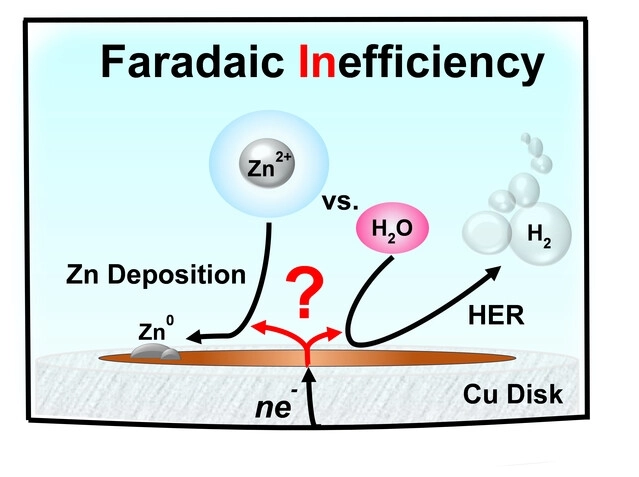
In-situ EC-MS quantifies hydrogen evolution during Zn electrodeposition with high precision — finding that just 0.3% of charge goes to HER at 1.5 mA cm⁻², yet correlating this with porous morphology, trapped H₂, and corrosion that cumulatively threaten long-term cycling. The method establishes a platform for accurately benchmarking electrolyte additives and electrode modifications in aqueous Zn batteries.
Probing Degradation in Lithium Ion Batteries with On-Chip Electrochemistry Mass Spectrometry
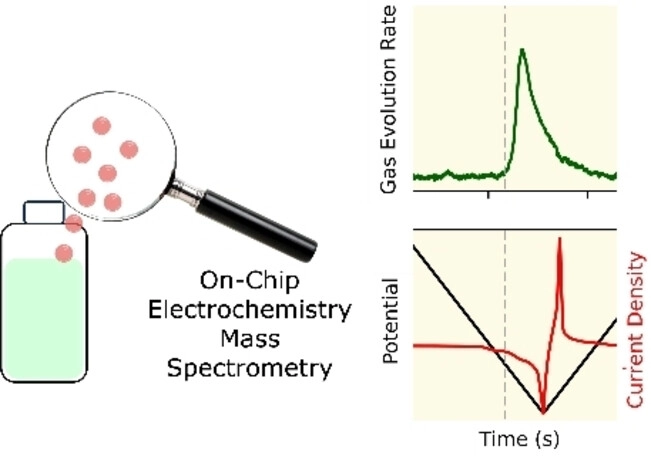
On-chip EC-MS enables fully quantified, time-resolved detection of gases from operating lithium-ion batteries — revealing oxygen evolution from NMC cathodes, SEI formation across electrolytes, and the first direct evidence of CO₂ reduction to ethylene. The technique decouples parasitic reactions that drive capacity fade, providing a tool to validate and guide battery lifetime models.
Correlating oxygen functionalities and electrochemical durability of carbon supports for electrocatalysts
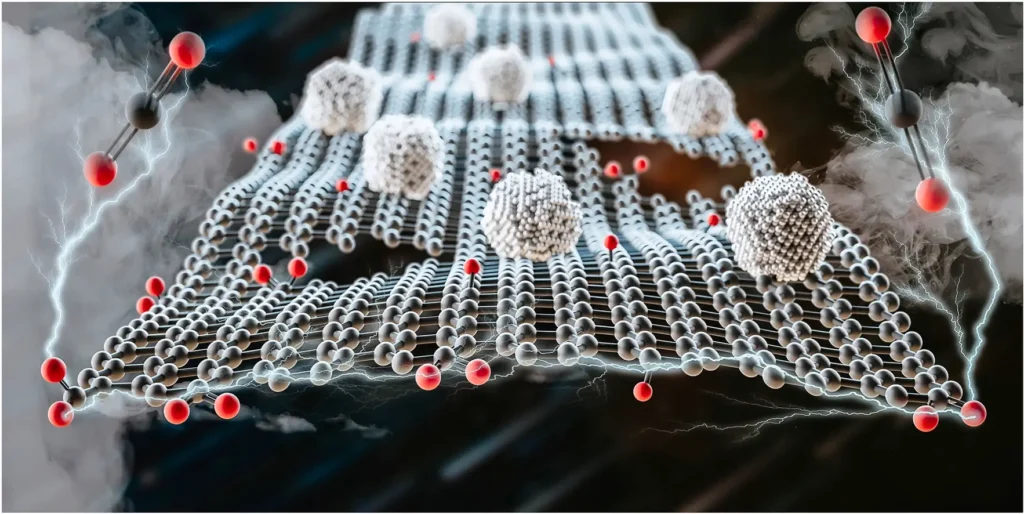
EC-MS combined with XPS accelerated degradation tests identifies sp2 carbon content and carboxyl group concentration as the key durability levers for carbon supports in Pt alloy fuel cell catalysts. Increasing sp2 content and reducing carboxyl groups yields the greatest stability gains — providing actionable guidelines for carbon support design toward DOE lifetime targets.
Searching for the Rules of Electrochemical Nitrogen Fixation
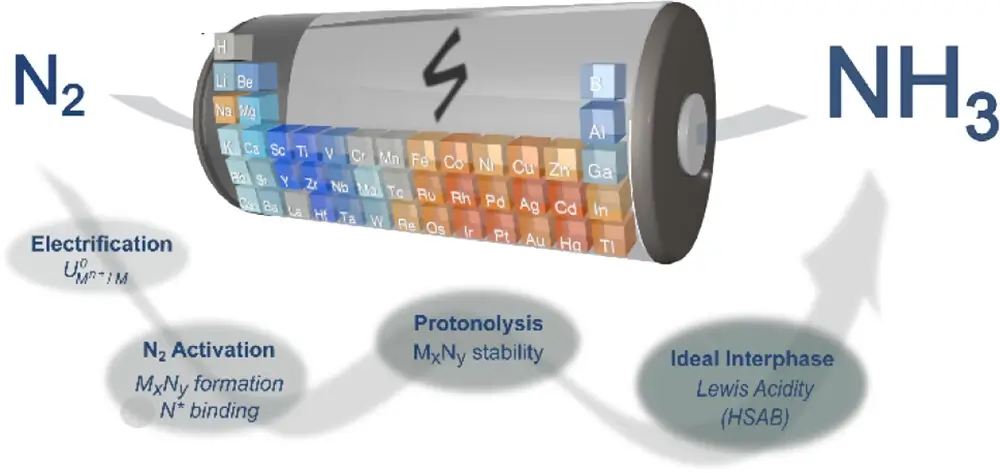
DFT calculations and experimentation across analogous chemistries (Na, Mg, Ca) confirm lithium’s uniqueness for electrochemical nitrogen fixation — combining a stable nitride that decomposes readily to ammonia with an ideal solid electrolyte interphase. Proposed descriptors based on formation energies and HSAB principles provide a framework for identifying viable beyond-Li systems.
Determining the potential-dependent identity of methane adsorbates at Pt electrodes using EC-MS
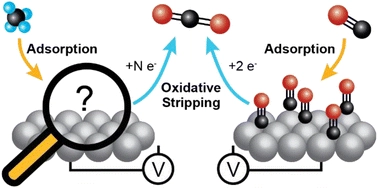
EC-MS reveals that methane adsorption on Pt peaks at 0.3 V vs. RHE and produces *CO as the dominant surface intermediate regardless of adsorption potential — explaining Pt’s poor performance for partial methane oxidation and pointing toward the catalyst properties needed for selective electrochemical methane valorisation.
Benchmarking Electrocatalyst Stability for Acidic Oxygen Evolution Reaction: The Crucial Role of Dissolved Ion Concentration
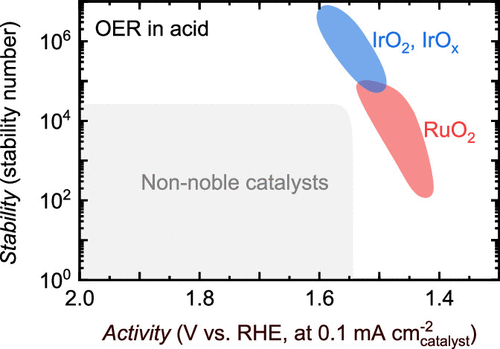
Dissolved ion concentration in confined electrolyte volumes creates a Nernst shift that artificially inflates measured RuO₂ stability — a systematic bias that distorts comparisons across cell types and underlies many claims of excellent non-noble catalyst stability. Correcting for this reveals RuO₂ to be 2 orders of magnitude less stable than IrO₂, though 10× more active, with noble catalysts outperforming non-noble alternatives on both metrics.