Anodic molecular hydrogen formation on Ru and Cu electrodes
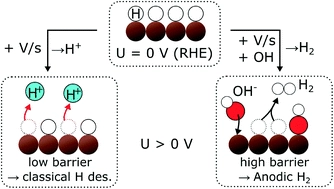
A previously undiscovered phenomenon: adsorbed hydrogen on Ru and Cu electrodes desorbs as H₂ during anodic sweeps — at potentials where H⁺ desorption would be expected. Observed and quantified via EC-MS on Ru(0001) in acid and polycrystalline Cu in alkaline, the effect appears linked to *OH adsorption and a high barrier for the Volmer step, favouring Tafel-step H₂ desorption over the thermodynamically preferred H⁺ route.
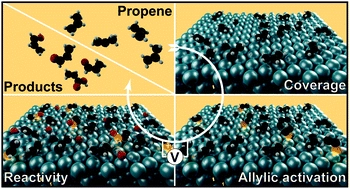
Towards an atomistic understanding of electrocatalytic partial hydrocarbon oxidation propene on palladium
NiFeOxHy water oxidation nanoparticle size and lattice oxygen studied by operando EC-MS shows OER in 1M KOH is surface-limited at a record 6.2 s-1.
Impact of nanoparticle size and lattice oxygen on water oxidation on NiFeOxHy
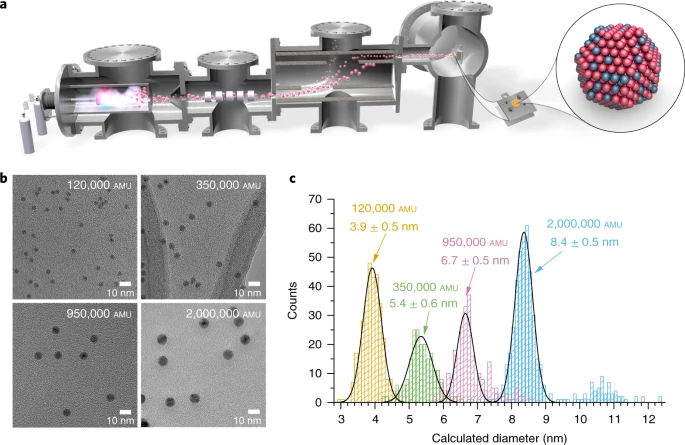
NiFeOxHy water oxidation nanoparticle size and lattice oxygen studied by operando EC-MS shows OER in 1M KOH is surface-limited at a record 6.2 s-1.
Enabling real-time detection of electrochemical desorption phenomena with sub-monolayer sensitivity
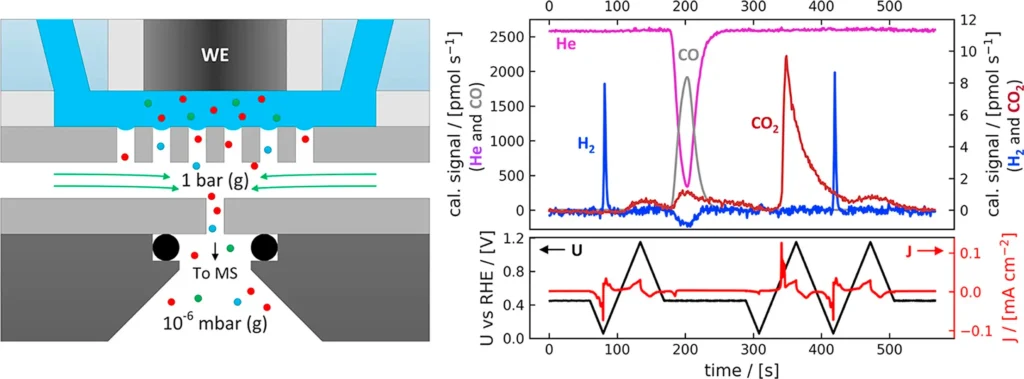
A silicon microchip gas inlet couples directly to a mass spectrometer, capturing electrode reaction products in real-time with 100% collection efficiency and sub-second response. The result is sub-turnover resolution for electrochemical analysis — sensitivity and time-response beyond established EC-MS techniques.
Real-time detection of sub-monolayer desorption phenomena during electrochemical reactions: Instrument development and applications
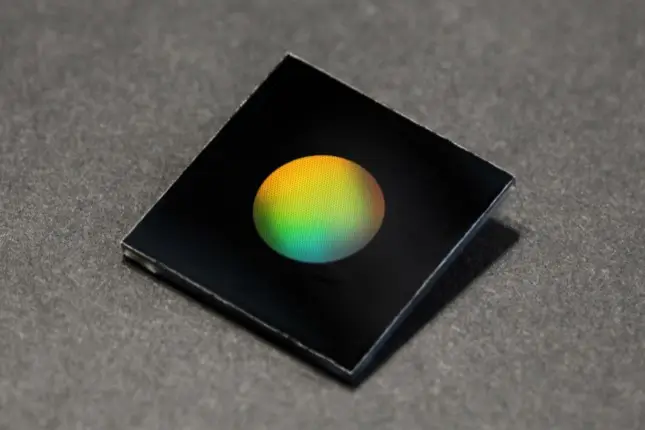
A microfabricated membrane chip enables direct, loss-free coupling between wet electrochemistry and a mass spectrometer vacuum — delivering higher sensitivity than conventional DEMS with no compromise on response time. The system achieves 100% collection efficiency and sub-monolayer detection, and is used to uncover a new CO reduction pathway on copper: pre-exposure to dioxygen temporarily enables enhanced methane production, explained via DFT as an oxygen-induced geometric effect at kink sites.
A device for extracting volatile species from a liquid
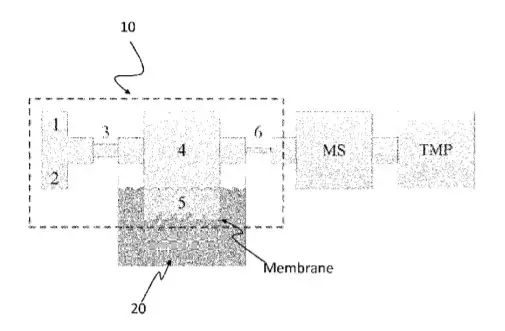
A device for extracting volatile species from liquids using a membrane chamber at zero differential pressure, feeding into a carrier gas stream and out through a capillary directly to a mass spectrometer. No differential pumping required – combining the fast response of DEMS with the high sensitivity of MIMS.
Fast and sensitive method for detecting volatile species in liquids
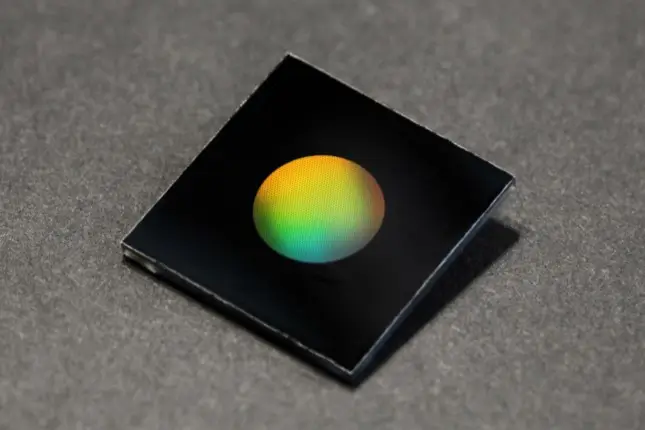
A novel sniffer-chip apparatus extracts volatile species from liquids via a hydrophobic membrane into a carrier gas stream, delivering them directly to a mass spectrometer. The method combines the fast response of DEMS with the sensitivity of MIMS — capable of detecting sub-monolayer surface reactions at faradaic currents down to ~30 nA.